Why Cloud-Based Management is the Future for Hammams
The traditional hammam has been a cornerstone of Moroccan culture for centuries. The rituals, the community, the sense of renewal — these things haven’t changed. But the business side of running a hammam in 2026 looks nothing like it did even a decade ago.
Customer expectations are higher, competition is fiercer, and the tools available to manage your business have evolved dramatically. If you’re still relying on paper notebooks, Excel spreadsheets, or locally installed software, here’s why it’s time to make the move to the cloud — and what that transition actually looks like in practice.
The Problem with Paper and Local Software
Before we talk about the benefits of cloud-based management, let’s be honest about the problems with the status quo. Many hammam owners we’ve spoken to describe the same challenges:
Paper-Based Systems
- Lost or damaged records. A spilled glass of tea, a misplaced notebook, or simply running out of pages can mean lost client data and booking history.
- No searchability. Need to find a client’s last visit from three months ago? Good luck flipping through pages of handwritten notes.
- No reporting. You can’t easily calculate your monthly revenue, no-show rate, or busiest days from a paper calendar.
- Single point of failure. If the notebook is at the front desk, nobody else can access the schedule from another location.
Locally Installed Software
- Tied to one computer. If that computer breaks, your entire business management system is offline until it’s repaired.
- Manual backups. How often do you back up your data? For most businesses, the answer is “not often enough.”
- Expensive updates. New versions often require purchasing a new license, sometimes with compatibility issues.
- No remote access. You can only manage your business when you’re physically at the location.
These aren’t hypothetical problems. We’ve met hammam owners who lost months of financial records to a hard drive failure, and others who discovered double-bookings only when two clients showed up for the same time slot because the paper calendar wasn’t updated.
Access Your Business From Anywhere
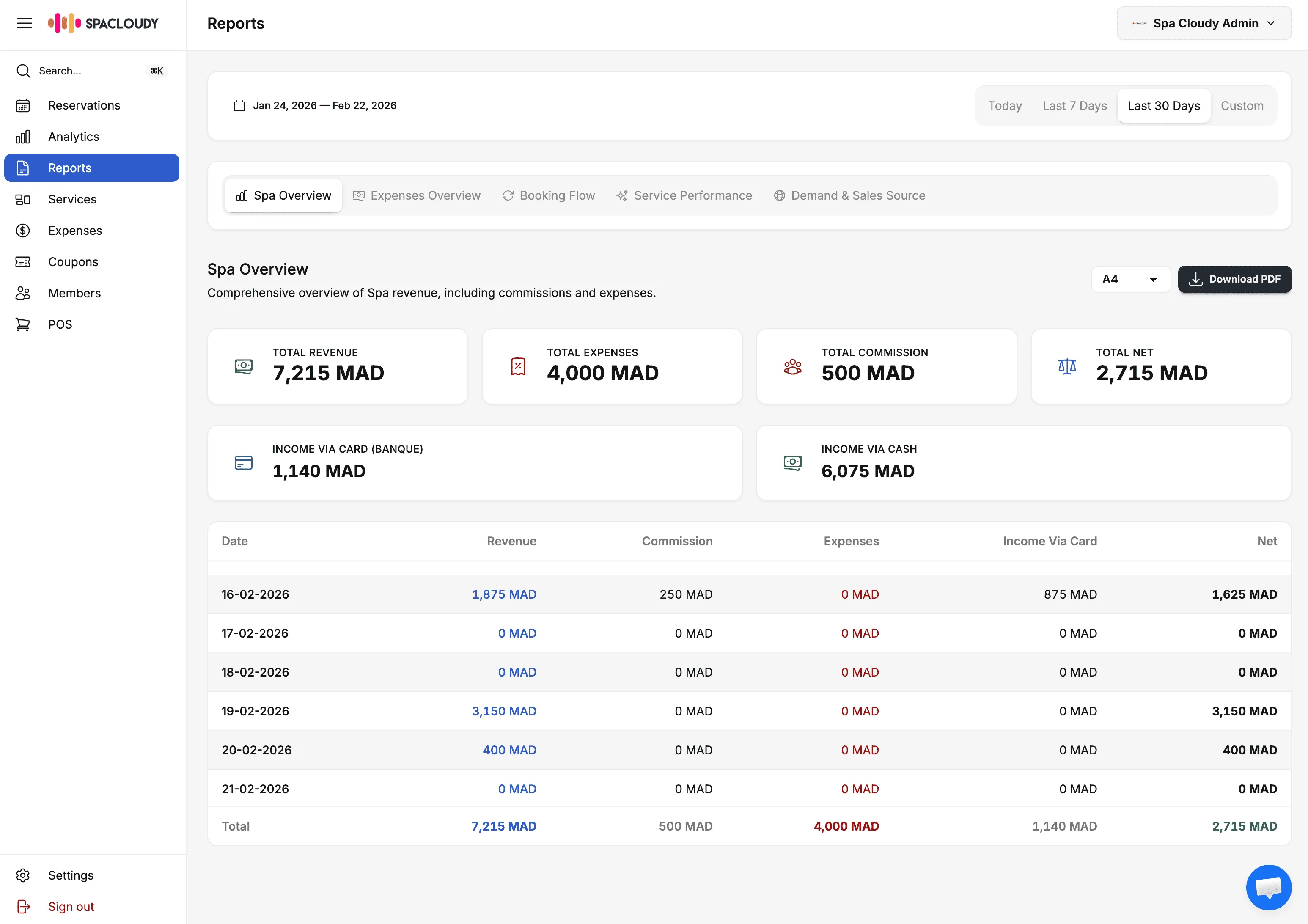
Cloud-based management means your data isn’t locked on a single computer behind the front desk. Whether you’re at home, traveling, or managing a second location across town, you can:
- Check today’s reservations from your phone
- Review yesterday’s revenue from your laptop
- Approve a staff schedule change from anywhere
- Monitor booking trends while you’re away
This flexibility is especially valuable for multi-location owners who can’t be physically present at every site every day. But even single-location owners benefit from the peace of mind of knowing they can check on their business anytime.
A Real-World Example
Consider a hammam owner who takes Fridays off. With a paper system, she’d need to call the front desk to check if the day was busy, ask about any problems, and hope nothing was missed. With a cloud system, she can open the app on her phone, see exactly how many bookings came in, check the day’s revenue, and even review any client notes — all in under a minute, without interrupting her team.
Never Lose Your Data
Paper records get lost. Local hard drives fail. USB backups get forgotten. These aren’t edge cases — they’re everyday realities for businesses without proper data protection.
Cloud systems automatically back up your data daily, and it’s protected by industry-standard encryption. Your customer records, financial data, and booking history are safe — even if your front desk computer crashes tomorrow.
What “Industry-Standard Encryption” Actually Means
When we say your data is encrypted, here’s what that means in practice:
- In transit. Every time you access your account, the connection is encrypted using TLS (the same technology that protects online banking). Nobody can intercept your data as it travels between your device and our servers.
- At rest. Your data is stored in encrypted form on the server. Even if someone somehow accessed the physical storage, they couldn’t read your data without the encryption keys.
- Regular backups. Your data is automatically backed up every day. If anything goes wrong, we can restore your account to any point in the past 30 days.
For a hammam owner, this means you never have to worry about losing your client database, booking history, or financial records. It’s all protected, automatically.
Stay Up to Date Without IT Hassles
With locally installed software, every update means downtime, installation headaches, and compatibility issues. You might avoid updates because they’re disruptive, which means you miss out on new features and security patches.
Cloud platforms update automatically. You always have the latest features, security patches, and improvements without lifting a finger. When you open your dashboard in the morning, everything just works — and occasionally, there’s a new feature waiting for you that wasn’t there yesterday.
The Hidden Cost of Outdated Software
Running old software isn’t just inconvenient — it’s a security risk. Outdated software often has known vulnerabilities that hackers can exploit. For a business that handles client data (names, phone numbers, booking history), this isn’t a risk worth taking.
With a cloud platform, security updates are applied automatically, often before you even know there was a vulnerability to fix.
Scale Effortlessly
Opening a second hammam? A cloud platform lets you add a new location to your account in minutes. Your data stays isolated per location (so staff at Location A can’t see Location B’s financials), but you get unified reporting across all your businesses.
No need to buy another software license, set up a separate system, or hire an IT consultant. Just add the new location, invite the new team, and start managing both from a single dashboard.
What Multi-Location Management Looks Like
Here’s how a typical multi-location workflow works with cloud-based management:
- Morning check. Open your dashboard, see a unified overview of all locations: today’s bookings, yesterday’s revenue, any alerts.
- Location drill-down. Tap into a specific location to see detailed data: staff schedules, booking status, client notes.
- Cross-location reporting. Generate a weekly report that compares revenue, booking volume, and no-show rates across all locations.
- Staff management. Assign a therapist who works at both locations to the right shifts at the right place.
This kind of visibility would be nearly impossible with separate paper systems or isolated software installations.
Lower Costs, Better Value
Cloud platforms typically operate on a subscription model — a predictable monthly cost that includes hosting, backups, updates, and support. Compare that to the upfront cost of buying software, plus the ongoing expense of maintaining servers and paying for IT support.
Let’s break down the numbers for a typical hammam:
Traditional Software Costs
- Software license: 5,000-15,000 DH (one-time)
- Computer/hardware: 3,000-8,000 DH
- IT setup and maintenance: 1,000-3,000 DH/year
- Manual backups: time-consuming, often skipped
- Updates: additional license fees every 2-3 years
- Total first year: 9,000-26,000 DH
Cloud Platform Costs
- Monthly subscription: 295-995 DH/month depending on plan
- No hardware requirements beyond a phone or tablet
- Backups, updates, and support included
- Total first year: 3,540-11,940 DH
For a hammam owner, the math is simple: you get more capabilities for a fraction of the cost. And because it’s a monthly subscription, you can cancel anytime if it’s not working for you — no sunk cost from an expensive software license.
Common Concerns About Moving to the Cloud
We understand that change can be daunting, especially when your current system “works fine.” Here are the most common concerns we hear from hammam owners and how we address them:
“What if the internet goes down?”
Modern cloud apps cache essential data locally on your device. You can still view your schedule and client information offline. When the connection returns, everything syncs automatically. That said, in 2026, internet reliability in Moroccan cities is strong enough that this is rarely an issue.
”I’m not tech-savvy.”
Cloud platforms are designed to be simpler than the systems they replace, not more complex. If you can use WhatsApp, you can use a cloud management tool. Most of our users are fully comfortable within the first day.
”My staff won’t adapt.”
Staff adoption is usually faster than owners expect. The key is that cloud tools make their jobs easier — less paperwork, fewer phone calls, clearer schedules. When staff see the immediate benefit, they embrace the change.
”Is my data really safe?”
Safer than it is in a paper notebook or on a single computer. Cloud platforms invest heavily in security infrastructure — encryption, backups, access controls — because their entire business depends on keeping your data safe.
The Bottom Line
Cloud-based management isn’t just a trend — it’s the practical choice for hammam owners who want to spend less time on administration and more time delivering exceptional experiences to their clients.
The transition doesn’t have to be painful. Most businesses can migrate to a cloud system in a single afternoon, and the benefits — remote access, automatic backups, effortless scaling, lower costs — start from day one.
The future of hammam management is accessible, secure, and built for how you actually work. And it’s available today.
Get started with Spa Cloudy — free for 14 days, no credit card required.
Youssef Mazraoui
Founder & CEO at Spa Cloudy
Youssef has spent over 5 years working with hammam, spa, and salon owners across Morocco. He founded Spa Cloudy to bring modern cloud management tools to the wellness industry, helping hundreds of businesses streamline their daily operations.