10 Proven Strategies to Grow Your Massage Therapy Business
Growing a massage therapy business requires more than skilled hands and a calming ambiance. The wellness industry is competitive, and talented therapists who lack a growth strategy often find themselves stuck — fully booked on Saturdays but struggling to fill weekday slots, dependent on a handful of loyal clients, and unable to invest in the staff or space they need to expand. Sound familiar?
The good news is that massage business growth follows predictable patterns. The practices that consistently attract new clients, increase rebooking rates, and scale revenue are well documented. This article lays out ten proven strategies that massage therapy business owners are using right now to build thriving, sustainable practices. Each strategy is actionable, and most can be implemented without a large budget.
1. Build a Strong Online Presence
Your online presence is often the first impression a potential client has of your massage therapy business. If they cannot find you, learn about your services, and book easily, they will choose a competitor who makes it simple.
Google Business Profile
Claim and fully optimize your Google Business Profile. This is the single most important step for local visibility. Add your business name, address, phone number, website, and operating hours. Upload high-quality photos of your space, treatment rooms, and team. Select the correct business categories — “Massage Therapist” and “Spa” are the most relevant. Post updates regularly about new services, seasonal promotions, or wellness tips. A complete and active Google Business Profile dramatically improves your chances of appearing in the local map pack when someone searches for “massage near me.”
Social Media That Converts
You do not need to be on every platform. Choose one or two where your target clients spend time — Instagram and Facebook are typically the strongest channels for wellness businesses. Post consistently with a mix of content: behind-the-scenes glimpses of your space, educational posts about the benefits of massage therapy, client testimonials (with permission), and clear calls to action with a link to your booking page. Social media builds trust and familiarity before a potential client ever walks through your door.
A Website That Works Around the Clock
Your website does not need to be elaborate, but it must accomplish three things: explain your services clearly, convey professionalism and trust, and make booking effortless. An integrated massage booking system that lets visitors schedule an appointment directly from your website — without calling, messaging, or navigating away — converts browsers into clients. Every extra step in the booking process is an opportunity for the potential client to abandon the effort.
2. Offer a Signature Service That Differentiates You
In a market where many massage therapy businesses offer similar menus of Swedish, deep tissue, and hot stone treatments, a signature service gives clients a specific reason to choose you. This is not about inventing something entirely new — it is about packaging and positioning a service in a way that feels unique to your practice.
Perhaps it is a 90-minute “Recovery Ritual” that combines deep tissue work with aromatherapy and hot towels. Maybe it is a “Desk Worker Reset” targeting the neck, shoulders, and lower back for professionals who sit all day. Or a “Hammam & Massage Journey” that pairs a traditional steam session with a full-body massage. The name, the description, and the experience should be distinctive enough that clients talk about it and remember it.
A signature service also gives you a powerful marketing anchor. Instead of promoting generic “massage therapy” — which every competitor offers — you promote something that only your business provides. This differentiation attracts new clients and gives existing clients a reason to try something beyond their usual booking.
3. Master the Art of Rebooking at Checkout
The moment a client finishes their massage and feels relaxed, grateful, and positive about the experience is the single best moment to secure their next appointment. Yet many massage therapists let this opportunity pass by simply saying “see you next time” and hoping the client remembers to book again eventually.
Train your front desk — or handle it yourself if you are a solo practitioner — to offer rebooking as a natural part of the checkout process. The script can be simple: “You mentioned your shoulders have been really tight lately. Most of my clients with similar tension find that coming every three to four weeks keeps things manageable. Would you like to book your next session now so you can get the time slot that works best for you?”
This is not pushy. It is helpful. And it works. Massage therapy businesses that systematically rebook at checkout see dramatically higher client retention rates compared to those that rely on clients to initiate their next appointment. When the next visit is already on the calendar, inertia works in your favor instead of against you.
4. Implement Automated Appointment Reminders
No-shows and last-minute cancellations are among the most frustrating and costly problems in the massage therapy business. A one-hour slot that goes unfilled because a client forgot their appointment represents pure lost revenue — the therapist was available, the room was prepared, and no replacement client could be found on short notice.
Automated appointment reminders sent via SMS or WhatsApp 24 to 48 hours before the scheduled time are remarkably effective. Massage practices that implement automated reminders through their massage booking system typically see no-show rates drop by up to 60%. The reminder serves a dual purpose: it prompts forgetful clients to confirm and show up, and it gives clients who genuinely cannot make it enough time to cancel or reschedule, allowing you to offer the slot to someone on your waitlist.
The key word here is automated. Manually texting reminders to every client is time-consuming and error-prone. A massage appointment system that sends reminders automatically — triggered by the booking itself — requires no ongoing effort from you or your staff. Set it up once and let the system protect your revenue indefinitely.
5. Create a Loyalty Program That Actually Works
Client retention is the engine of massage business growth. Acquiring a new client costs five to seven times more than retaining an existing one, and loyal clients spend more per visit, book more frequently, and refer others. A well-designed loyalty program accelerates all three behaviors.
Points-Based Rewards
The simplest approach awards points for every visit or every dirham spent. When a client accumulates enough points, they earn a reward — a free add-on service, a discount on their next booking, or a complimentary product. The key is making the rewards attainable enough to motivate behavior but valuable enough to feel meaningful. A loyalty program that requires 50 visits to earn a free massage is not motivating anyone.
Packages and Prepaid Sessions
Selling packages of five or ten sessions at a discounted rate accomplishes two things: it secures future revenue upfront and creates a psychological commitment that drives repeat visits. A client who has purchased a package of eight massages will make sure they use every one of them, guaranteeing eight visits that might otherwise have been uncertain.
Membership Tiers
For massage therapy businesses with a large enough client base, tiered membership programs create aspirational levels of loyalty. A basic tier might offer a monthly massage at a preferred rate. A premium tier adds priority booking, complimentary upgrades, and exclusive access to new services. Memberships provide predictable recurring revenue — the holy grail for wellness business financial stability.
The most effective loyalty programs are integrated directly into your massage booking and management software, so points are tracked automatically, rewards are applied at checkout without manual intervention, and you can measure the program’s impact on retention and revenue with real data.
6. Use Analytics to Identify Your Most Profitable Services and Time Slots
Gut feeling is a poor substitute for data when making decisions about your massage therapy business. Analytics reveal truths that intuition misses, and acting on those truths is one of the fastest paths to growth.
Service Profitability
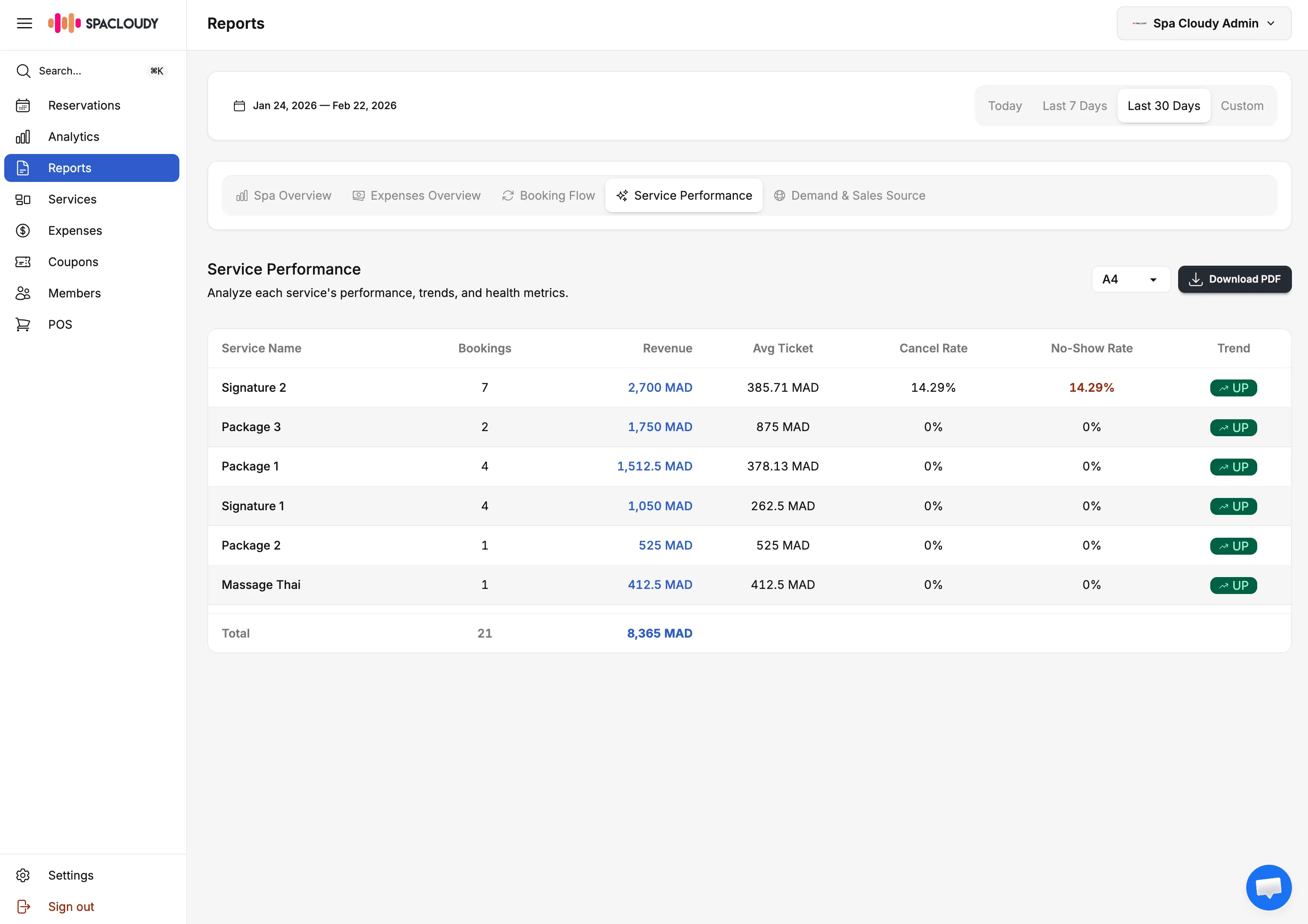
Not all services contribute equally to your bottom line. A 60-minute deep tissue massage and a 60-minute relaxation massage might generate the same revenue, but if one requires more expensive products, more therapist energy, or more preparation time, their actual profitability differs. Your spa management software should help you compare services by revenue, margin, booking frequency, and client satisfaction so you can promote and prioritize the treatments that contribute most to your business.
Time Slot Optimization
Analyzing booking patterns reveals which days and times are consistently popular and which are chronically underbooked. Armed with this data, you can implement targeted strategies to fill weak spots: offering a “Tuesday afternoon special” discount, encouraging corporate bookings during midweek lulls, or adjusting staff schedules to reduce labor costs during predictably slow periods. Every filled slot that would otherwise sit empty is pure incremental revenue.
Client Segmentation
Analytics can also reveal patterns in your client base. Who are your highest-value clients? How often do they visit? Which services do they prefer? Are there clients who used to visit regularly but have not booked in months? Segmenting your client base allows you to tailor your marketing and outreach — sending win-back offers to lapsed clients, VIP perks to your top spenders, and introductory promotions to first-time visitors.
7. Train Your Team for Consistency and Upselling
If your massage therapy business employs multiple therapists, the client experience must be consistent regardless of who performs the service. Inconsistency is one of the fastest ways to lose clients — if a customer has an excellent experience with one therapist and a mediocre one with another, their overall impression of your business suffers.
Standardize Service Protocols
Document the key elements of every service you offer: the greeting, the consultation, the technique sequence, the products used, the closing, and the aftercare advice. This does not mean eliminating individual therapist style — it means ensuring a baseline quality that every client can count on. Regular team meetings to discuss techniques, share feedback, and practice new skills keep standards high.
Teach Thoughtful Upselling
Upselling in a massage therapy context is not about pressuring clients into spending more. It is about recommending additions that genuinely enhance their experience. A therapist who notices significant tension in a client’s neck might suggest adding 15 minutes of focused neck and shoulder work. A front desk team member might recommend a hydrating body treatment as a complement to a deep tissue session during winter months.
When upselling is framed as personalized care rather than a sales pitch, clients appreciate it. And the revenue impact is significant — if just 20% of your clients accept a modest upsell averaging 100 MAD, and you see 150 clients per month, that is 3,000 MAD in additional monthly revenue with virtually no incremental cost.
8. Optimize Your Pricing Strategy
Pricing is one of the most powerful levers for massage business growth, yet many practitioners set their prices once and never revisit them. A thoughtful pricing strategy balances accessibility with profitability and uses price variation to manage demand.
Peak and Off-Peak Pricing
Charging a slightly higher rate for prime-time slots (Saturday mornings, weekday evenings after work) and a discounted rate for traditionally slow periods (Tuesday afternoons, early mornings) smooths out demand naturally. Clients who are price-sensitive will gravitate toward off-peak times, filling slots that would otherwise sit empty. Clients who need the convenience of peak times will pay the premium willingly. Both segments are better served.
Package and Bundle Pricing
As mentioned in the loyalty section, packages offer a discount per session in exchange for an upfront commitment. But you can also bundle complementary services — such as a massage plus a facial, or a hammam session plus an aromatherapy massage — at a price lower than booking each service separately. Bundles increase the average transaction value while giving clients a perception of enhanced value.
Annual Price Reviews
Your costs increase over time — rent, products, insurance, staff wages. If your prices remain static, your margins erode. Review your pricing at least once a year. Incremental increases of 3% to 5% annually are generally absorbed by clients without pushback, especially when accompanied by genuine improvements in service quality or offerings. Delaying price increases for years and then implementing a large jump is far more likely to trigger client resistance.
9. Leverage Client Reviews and Referrals
Word of mouth remains the most trusted form of marketing, and in the digital age, word of mouth lives online as reviews and referrals.
Google Reviews Are Non-Negotiable
The number and quality of your Google reviews directly affect your visibility in local search results and your credibility with potential clients. Make it easy for satisfied clients to leave a review by sending a follow-up message with a direct link to your Google review page. Timing matters — send the request within a few hours of their visit, while the positive experience is fresh. A simple message like “We loved having you today! If you have a moment, a Google review would mean the world to us” is sufficient. Aim for consistent, steady review accumulation rather than occasional bursts.
Referral Incentives That Drive Action
A formal referral program gives your happiest clients a reason to actively recommend you. Offer a reward for both the referrer and the new client — for example, both receive a discount on their next booking. This dual incentive makes the referral feel generous rather than self-serving. Track referrals through your massage booking system so you can measure which clients are your best advocates and thank them appropriately.
Respond to Every Review
Whether a review is glowing or critical, respond professionally and promptly. Thank positive reviewers by name. Address negative feedback with empathy and a genuine desire to resolve the issue. Potential clients reading reviews pay close attention to how a business handles criticism — a thoughtful response to a complaint can actually build more trust than a five-star review.
10. Invest in Management Software That Grows With You
The thread connecting all nine previous strategies is this: they become dramatically easier to execute and measure when you have the right management software in place.
Centralized massage booking eliminates scheduling chaos and enables online reservations. A built-in POS tracks every transaction accurately. CRM features store client profiles and power personalized communication. Automated reminders protect revenue from no-shows. Analytics dashboards reveal which services, time slots, and team members are driving growth. Loyalty program tools automate rewards and track retention.
Trying to manage all of this with a patchwork of paper records, spreadsheets, WhatsApp groups, and separate apps is not just inefficient — it is a ceiling on your growth. At some point, the complexity of running a growing massage therapy business exceeds what manual systems can handle, and the cracks start to show in missed appointments, lost client data, and decisions made without adequate information.
The right wellness business software does not just solve today’s problems. It provides the infrastructure for tomorrow’s growth. When you open a second location, the system should support it. When you hire additional therapists, onboarding them into the platform should take minutes. When you want to launch a loyalty program or a marketing campaign, the tools should already be there, integrated with your booking and client data.
What to Look For
Choose a massage appointment system that offers all the core capabilities — booking, POS, CRM, reminders, analytics — in a single platform. Ensure the interface is clean and intuitive so your team adopts it quickly. Confirm that data is stored securely in the cloud and accessible from any device. Verify that the pricing is transparent and scales reasonably as your business grows. And prioritize a vendor who understands the wellness industry specifically, because generic business software often misses the nuances of appointment-based, service-oriented businesses.
Putting It All Together
Growing a massage therapy business is not about finding a single silver bullet. It is about executing multiple strategies consistently, measuring their impact, and refining your approach based on real data. Build your online presence so new clients can find you. Differentiate with a signature service so they choose you. Rebook at checkout so they return. Use reminders so they actually show up. Reward loyalty so they stay. Analyze your data so you make smarter decisions. Train your team so every visit meets high standards. Price strategically so your margins support growth. Encourage reviews so your reputation compounds. And invest in software that ties everything together.
Each of these strategies delivers incremental improvement on its own. Together, they compound into transformative growth.
Ready to put these strategies into action? Try Spa Cloudy free for 14 days — no credit card required. Get centralized booking, automated reminders, client management, analytics, and everything else you need to grow your massage therapy business, all in one platform.
Youssef Mazraoui
Founder & CEO at Spa Cloudy
Youssef has spent over 5 years working with hammam, spa, and salon owners across Morocco. He founded Spa Cloudy to bring modern cloud management tools to the wellness industry, helping hundreds of businesses streamline their daily operations.