5 Ways to Streamline Your Spa Operations
Running a spa or hammam involves juggling dozens of daily tasks — from managing reservations and walk-ins to tracking revenue and coordinating staff. Without the right systems in place, these tasks eat into the time you could spend improving the customer experience.
After working with over 500 spa and hammam owners, we’ve identified the five most impactful operational changes that save time, reduce errors, and improve your bottom line. Here’s what works.
1. Centralize Your Reservation System
If you’re still using paper calendars, WhatsApp messages, or spreadsheets to track bookings, you’re leaving money on the table. Scattered booking systems lead to double-bookings, missed appointments, and frustrated clients who can’t get a clear answer about availability.
A centralized reservation system lets you:
- See all bookings at a glance with calendar and list views
- Filter by status (pending, confirmed, completed, cancelled)
- Track deposits and remaining balances automatically
- Avoid double-bookings with real-time availability checks
- Manage walk-ins alongside scheduled appointments
When everything lives in one place, your front desk team can handle walk-ins and appointments without confusion. One of our users, a hammam in Marrakech, reported cutting their booking errors by 90% within the first month after centralizing their reservations.
The Real Cost of Fragmented Booking
Consider what happens when a receptionist answers the phone while checking WhatsApp for another booking. They put one client on hold, check three different sources, and still aren’t sure if the 3 PM slot is available. Multiply this by 20 bookings a day, and you’re losing hours to a problem that shouldn’t exist.
A centralized system also makes it easy for any team member to step in at the front desk. They don’t need to know where the paper calendar is or which WhatsApp group has the latest updates — everything is right there on the screen.
2. Automate Repetitive Communication
How much time does your team spend calling clients to confirm appointments? In a typical spa with 30 daily bookings, that’s easily 1-2 hours spent on the phone — time your staff could use for in-person customer service.
Automated email and SMS reminders reduce no-shows by up to 25% and free your team to focus on what they do best: delivering great experiences.
How to Set Up Effective Reminders
The most effective reminder sequence works in two stages:
- Confirmation message — sent immediately when a booking is created. This reassures the client that their appointment is locked in and gives them the details (date, time, service, location).
- Reminder message — sent 24 hours before the appointment. A friendly nudge that includes an easy way to reschedule if their plans changed.
Your clients appreciate the professional touch, and you reduce last-minute gaps in your schedule. Some spa owners we’ve worked with have also added a third touchpoint: a brief “thank you” message sent 2 hours after the visit, asking for feedback or offering a rebooking discount.
Beyond Reminders: Communication That Builds Relationships
Automated communication isn’t just about reducing no-shows. It’s about creating a consistent, professional impression at every touchpoint. When a client receives a polished booking confirmation within seconds of making a reservation, it signals that your business is organized and cares about their experience.
Consider also automating:
- Birthday greetings with a small discount
- Re-engagement messages for clients who haven’t visited in 60+ days
- Seasonal promotions timed to your quieter months
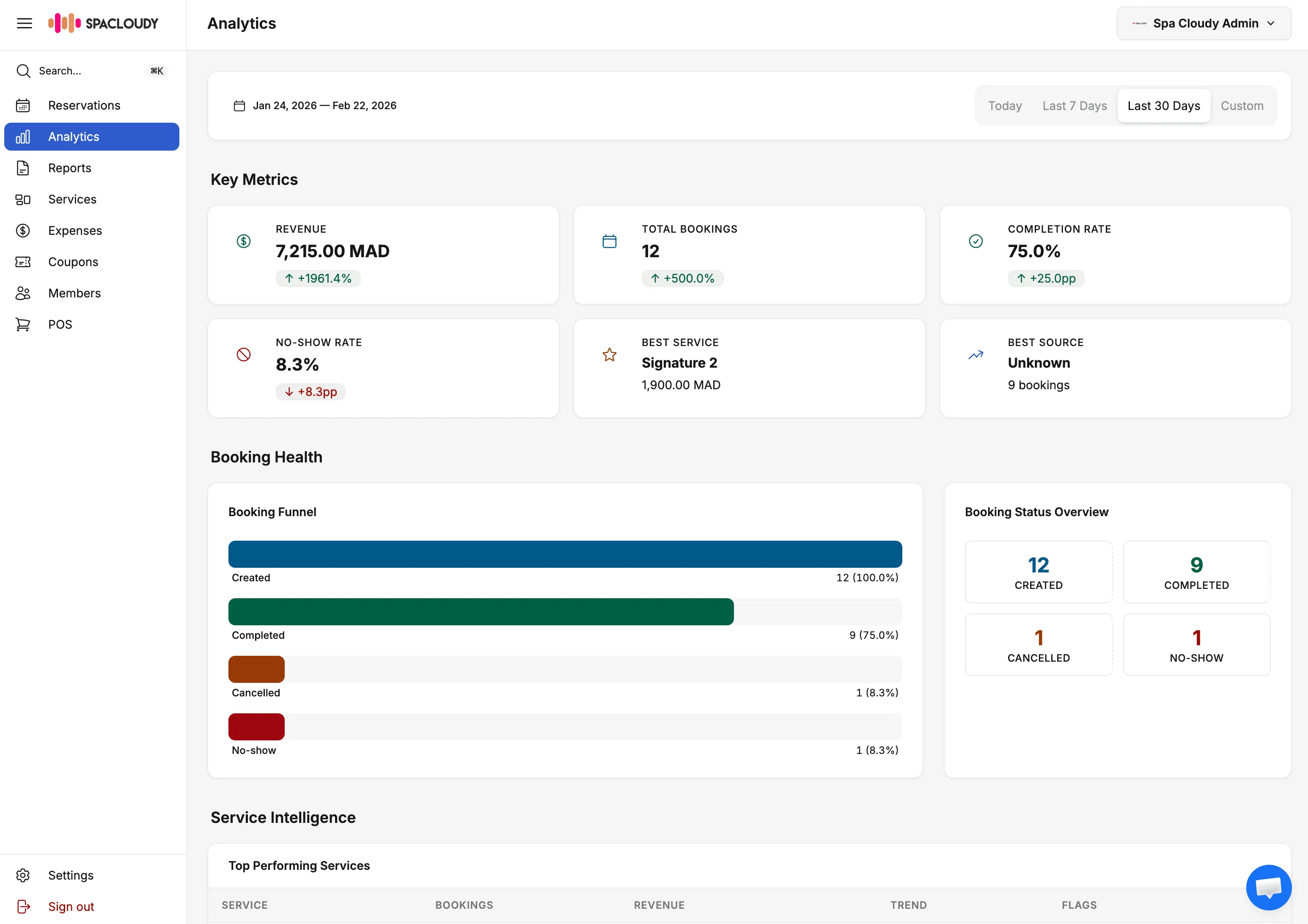
3. Use Real-Time Analytics to Make Decisions
Gut feelings are useful, but data is better. Too many spa owners make pricing, staffing, and marketing decisions based on intuition alone — and end up overstaffed on slow days or running promotions on services that are already fully booked.
A real-time analytics dashboard helps you answer critical business questions:
- Which services generate the most revenue? You might discover that your premium packages account for 40% of revenue despite being only 15% of bookings.
- What are your peak booking hours? Knowing that Saturdays between 10 AM and 2 PM are your busiest period lets you staff accordingly.
- How does this month compare to last month? Trend data helps you spot seasonal patterns and plan ahead.
- Which staff members have the highest completion rates? This helps with scheduling, training, and fair commission structures.
Turning Data Into Action
Having analytics is one thing. Acting on them is another. Here’s a framework that works:
Weekly review (15 minutes): Check your revenue dashboard. Are bookings up or down compared to last week? Any services trending in the wrong direction?
Monthly deep dive (30 minutes): Review your top-performing services, busiest time slots, and staff performance. Adjust staffing schedules, pricing, or promotions based on what the data shows.
Quarterly strategy session (1 hour): Look at 3-month trends. Are you growing? Which initiatives drove results? What should you try next quarter?
The goal isn’t to become a data scientist — it’s to make informed decisions instead of guessing.
4. Simplify Counter Transactions with a Built-in POS
If your point-of-sale system lives on a separate device or software from your booking system, you’re creating unnecessary friction. Your cashier has to switch between systems, manually cross-reference bookings, and reconcile two different sets of numbers at the end of the day.
An integrated POS lets your cashier:
- Look up services and products by category
- Process payments quickly at the counter
- Generate daily sales summaries automatically
- Keep all transaction data alongside your booking data
- Apply discounts or promotional codes in one step
Why Integration Matters
When your POS and booking system share the same database, you get benefits that separate systems can never provide:
- Automatic reconciliation. Every completed booking flows directly into your sales data. No manual entry, no discrepancies.
- Faster checkout. The cashier can pull up a client’s booked services instantly, add any additional items, and process payment in under 30 seconds.
- Unified reporting. Your daily revenue report includes both booked services and walk-in counter sales in a single view.
- Reduced errors. No more typos from re-entering booking amounts into a separate POS. The data flows automatically.
One salon owner told us that switching to an integrated POS saved them 45 minutes every day that they used to spend reconciling their booking system with their cash register.
5. Empower Your Staff with Role-Based Access
Not everyone on your team needs access to financial reports or business settings. In fact, giving everyone full access creates security risks and information overload. Role-based permissions let you give each team member exactly the access they need — no more, no less.
Here’s what a typical role structure looks like:
- Owners see everything: analytics, settings, financials, staff performance
- Managers handle day-to-day operations: bookings, staff schedules, customer management
- Cashiers access the POS, process payments, and view the booking calendar
- Employees view their own schedules, assigned reservations, and basic service details
The Benefits of Access Control
Security. Your financial data stays protected. Only the people who need to see revenue numbers can see them.
Focus. A therapist doesn’t need to see commission structures or expense reports. They need to see their schedule and client details. A clean, focused interface helps them do their job without distraction.
Accountability. When every action is tied to a specific user account, you can track who made changes, who processed which transactions, and who modified which bookings.
Scalability. As your team grows, role-based access ensures that new hires get the right level of access from day one. You don’t need to set up custom permissions for every person — just assign them a role.
This is especially important for multi-location businesses where managers need independence to run their location while owners maintain visibility across the entire operation.
Start Streamlining Today
These five strategies work together to reduce admin overhead and create a smoother experience for both your team and your clients. Each one addresses a specific operational pain point, and together they can save your business 2-3 hours of admin work every single day.
The best part? You don’t need five different tools to make it happen.
Spa Cloudy brings all of these capabilities into a single platform designed specifically for hammams, spas, and salons. Centralized bookings, automated communication, real-time analytics, integrated POS, and role-based access — all in one place.
Try it free for 14 days — no credit card required.
Youssef Mazraoui
Founder & CEO at Spa Cloudy
Youssef has spent over 5 years working with hammam, spa, and salon owners across Morocco. He founded Spa Cloudy to bring modern cloud management tools to the wellness industry, helping hundreds of businesses streamline their daily operations.