Hammam Al Andalous Fez: How a 3-Location Hammam Chain Recovered 20% Hidden Revenue
Results
Business Background
Hammam Al Andalous is one of Fez’s most established traditional hammam chains, with roots stretching back 12 years to when Omar Kettani opened the first location in the city’s historic Medina quarter. What began as a single, modestly sized neighborhood hammam has grown into a chain of 3 locations across Fez: the original Medina hammam, a larger facility in Ville Nouvelle catering to the city’s modern commercial district, and a newer location on Route de Sefrou serving Fez’s expanding southern suburbs.
Omar serves as Managing Director, overseeing a combined workforce of more than 25 staff members across all three locations, including hammam attendants (tayabat and keyssals), massage therapists, receptionists, maintenance staff, and location supervisors. Each hammam offers the full range of traditional Moroccan bathing services — steam rooms, black soap scrubs (gommage), ghassoul clay treatments, relaxation massages, and curated ritual packages — alongside modern spa additions like aromatherapy and facial treatments.
Hammam Al Andalous serves a diverse clientele: local Fassi families who visit weekly as part of their bathing routine, tourists drawn to the authentic medina experience, and a growing segment of wellness-oriented clients seeking premium hammam packages. On busy days — particularly Thursdays and Fridays, the traditional pre-weekend hammam days in Morocco — a single location can serve 60 to 80 clients.
Despite 12 years of steady growth and strong community reputation, Omar had long suspected that his business was underperforming relative to its potential. The problem wasn’t demand or quality — it was operational visibility. Or rather, the complete absence of it.
The Challenge
Hammam Al Andalous’s challenges were structural and systemic, the inevitable consequence of a multi-location business that had grown organically without ever implementing a unified management system.
Each location operated as an independent island. The Medina hammam — the oldest location — used a paper ledger system that dated back to its founding. The Ville Nouvelle location, opened four years later, adopted a slightly more modern approach with a basic cash register and a paper appointment book. The Route de Sefrou branch, the newest addition, used a mix of WhatsApp messages and a notebook. None of these systems were connected, and none produced data that could be meaningfully compared.
There was no centralized data of any kind. Omar had no single source of truth for revenue, client counts, staff scheduling, or service popularity across his three locations. Each location manager maintained their own records in their own format, and the numbers rarely aligned.
“I built this business over twelve years, but I couldn’t answer the most basic questions about it,” Omar says. “How much revenue did we generate last month across all locations? I would need three phone calls and a day of adding numbers to give you an answer — and I still wouldn’t be confident in it.”
Omar spent significant time physically driving between locations. Without digital visibility into what was happening at each hammam, Omar’s management style had become one of physical presence. He would visit each location at least twice per week — sometimes daily during busy periods — to review the books, resolve conflicts, check supplies, and speak with supervisors. For a man in his fifties managing a business across a city as geographically spread out as Fez (where the Medina and Route de Sefrou locations are 20+ kilometers apart), this was exhausting and unsustainable.
Revenue leakage from untracked walk-ins was a persistent and invisible problem. Hammam services, by their nature, attract a high volume of walk-in clients — people who decide spontaneously to visit the hammam, often without a reservation. In a paper-based system, not every walk-in was meticulously recorded. Busy attendants would sometimes serve clients and collect cash without writing down the transaction. Whether this was oversight or something more concerning, Omar had no way to know. What he knew was that the cash in the register at the end of the day didn’t always match what the foot traffic and service capacity would suggest.
Staff scheduling was chaotic across all three locations. With 25+ staff members spread across three hammams — some of whom floated between locations depending on demand — scheduling was a weekly nightmare. The Medina location might be overstaffed on a quiet Monday while the Ville Nouvelle branch was short-handed during a lunch rush. Requests for time off, shift swaps, and overtime were communicated verbally or through individual WhatsApp messages to supervisors, who frequently forgot to relay the information.
Weekly financial reconciliation consumed 6+ hours. Every weekend, Omar or his head of operations, Rachid Bennani, would sit down with the paper ledgers, cash register tapes, and notebook entries from all three locations and attempt to compile weekly financial figures. This process involved counting cash, cross-referencing receipt books, calling supervisors to clarify illegible entries, and manually entering totals into a spreadsheet. It was the single most dreaded task in the organization.
“The reconciliation process was like detective work,” says Rachid Bennani, head of operations. “We’d find discrepancies, and then it was a question of whether someone forgot to write something down, or wrote the wrong amount, or whether there was something more serious. We could never be sure, and that uncertainty was corrosive.”
The Solution
Omar’s decision to adopt hammam management software came after a particularly painful reconciliation weekend in which a 15,000-dirham discrepancy across the three locations took an entire Saturday to investigate and was ultimately attributed to a combination of unrecorded walk-ins and arithmetic errors in the paper ledgers.
He researched several options and chose Spa Cloudy for its multi-location management capabilities, its integrated POS system that would capture every transaction digitally, and its straightforward interface that didn’t require his staff — many of whom had limited technology experience — to become software experts.
The implementation followed a phased rollout over 3 weeks, deploying one location per week to manage the transition without disrupting client service.
Week 1: Ville Nouvelle (the pilot). Omar chose the Ville Nouvelle location as the pilot site because it was the most structured of the three and had the youngest, most tech-comfortable staff. The complete service catalog was built — all hammam packages, individual treatments, massage options, and add-ons — with standardized pricing. Five key staff members (the location supervisor, 2 receptionists, and 2 senior attendants) were trained on the booking system and POS. By the end of the week, every client interaction — walk-in or reservation — was being captured digitally.
Week 2: Route de Sefrou. The lessons from the Ville Nouvelle pilot were applied to the Route de Sefrou branch. The setup was faster, taking only two days. Three additional staff members were trained. The location supervisor reported that the system was already “easier than the notebook” by the second day.
Week 3: Medina. The original hammam — with the longest-tenured staff and the deepest attachment to paper-based processes — required the most careful change management. Omar and Rachid spent extra time walking the team through the system, emphasizing that the goal was to make their jobs easier rather than to add complexity. By mid-week, even the most skeptical attendants acknowledged that the digital system was faster than writing in the ledger.
In total, 8 key staff members were trained during the rollout, and they in turn helped onboard their colleagues at each location.
“I was most worried about the Medina team,” Omar admits. “Some of them have been with me since the beginning and have never used anything beyond a basic phone. But the interface is simple enough that once they saw how it worked, they adapted quickly. Rachid and I made sure to be present for the first few days at each location, answering questions and building confidence.”
Key features that addressed Hammam Al Andalous’s challenges:
- Digital walk-in registration ensured that every client — whether they booked in advance or walked in off the street — was recorded with their service and payment details. No more invisible transactions.
- Integrated POS at every location tied each payment directly to a recorded service and client, creating a complete audit trail that eliminated reconciliation ambiguity.
- Multi-location dashboard gave Omar real-time visibility into all three hammams from a single screen — revenue, client count, staff on duty, and pending bookings — without leaving his home.
- Centralized staff scheduling allowed supervisors to manage their team’s shifts digitally, with visibility across locations for floating staff, conflict detection, and automated notifications for schedule changes.
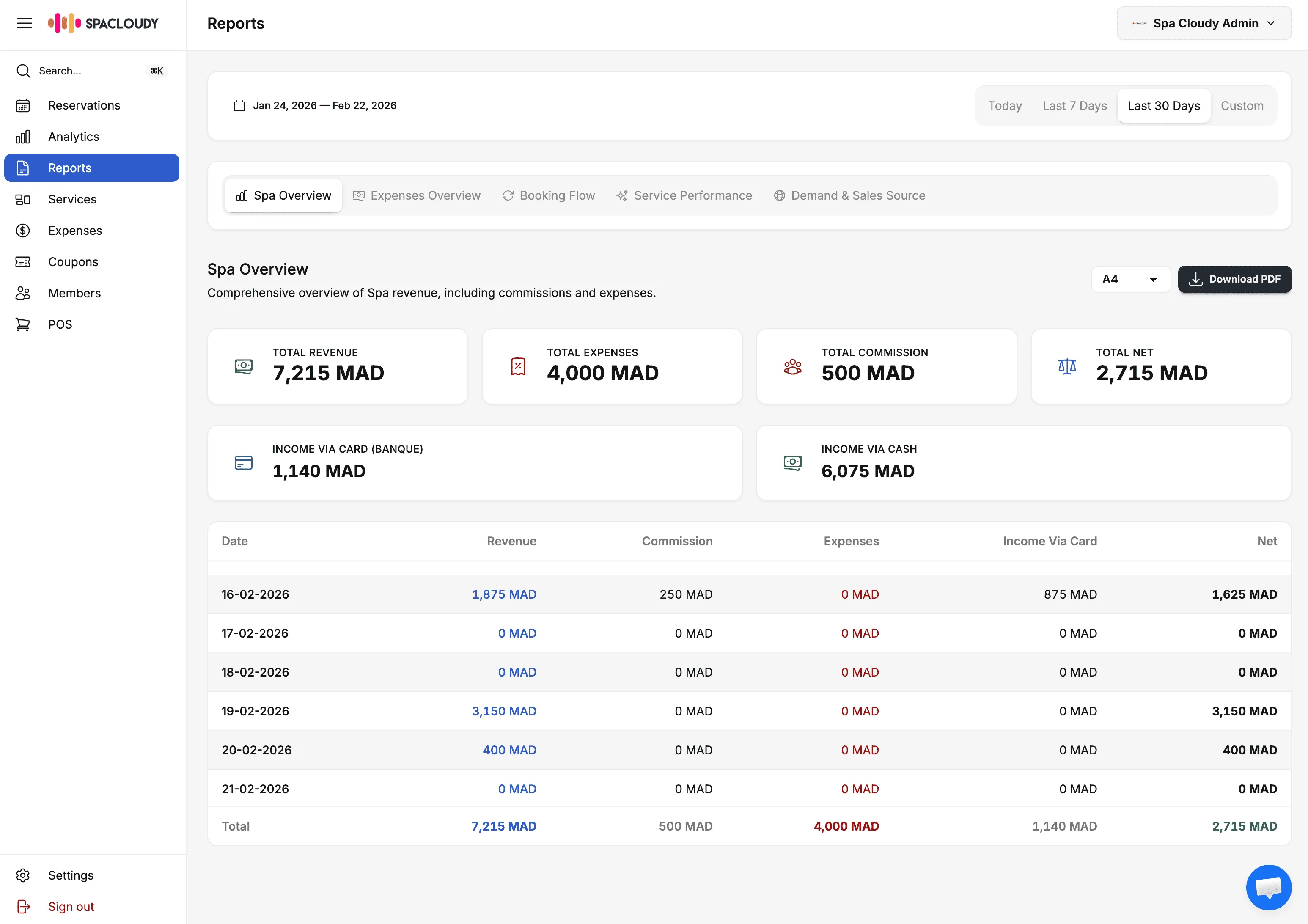
- Unified financial reporting compiled revenue, expenses, and key performance metrics across all three locations automatically, with drill-down capability by location, service, and time period.
The Outcome
The transformation at Hammam Al Andalous was measured carefully, and the results exceeded Omar’s expectations.
Revenue increased by 20% — almost entirely from previously untracked walk-ins. With every client interaction now digitally recorded and every payment processed through the POS, the “invisible” revenue that had been slipping through the paper-based cracks became visible and accountable. The 20% figure was striking not because the business grew by 20%, but because it revealed how much revenue had been there all along but simply wasn’t being captured. Omar estimates that at the Medina location alone, 10 to 15 walk-in transactions per day had been going unrecorded under the old system.
The weekly 6-hour reconciliation process was eliminated. What had been a Saturday-consuming ordeal of cross-referencing paper ledgers, counting cash, and making phone calls was replaced by a 15-minute review of the unified financial dashboard. Revenue figures were automatically compiled, discrepancies were flagged by the system, and end-of-day reconciliation at each location took minutes instead of an hour.
“The first Saturday after all three locations were on Spa Cloudy, I opened the dashboard, reviewed the numbers in fifteen minutes, and then didn’t know what to do with the rest of my day,” Rachid laughs. “I had forgotten what a free Saturday felt like.”
Staff scheduling conflicts were reduced by 85%. The centralized scheduling system eliminated the WhatsApp chaos of shift coordination. Supervisors could see their team’s availability at a glance, floating staff showed up at the right location at the right time, and time-off requests were tracked digitally rather than forgotten in a conversation thread.
Omar stopped driving between locations daily. With the multi-location dashboard providing real-time data from all three hammams, Omar’s management-by-presence approach was replaced by management-by-data. He now visits each location once or twice per week for quality checks and team engagement, rather than daily trips driven by the anxiety of not knowing what was happening.
“I used to say that my car was my office,” Omar reflects. “I was always driving to one hammam or another because that was the only way to know what was going on. Now my office is my phone. I check the dashboard in the morning with my coffee, and I know exactly what happened yesterday and what’s planned for today at every location. At sixty years old, I finally feel like I have my time back.”
Methodology
All outcomes reported in this case study were tracked via Spa Cloudy analytics dashboard, comparing Q4 2025 (pre-onboarding) vs. Q1 2026 (post-onboarding). Revenue figures were compared against the reconstructed paper-based records from Q4 2025, with the understanding that the pre-onboarding figures likely underrepresented actual activity due to unrecorded walk-ins. Staff scheduling conflict data was collected from supervisor incident reports during both periods. Reconciliation time was logged by Rachid Bennani during the baseline period and compared against the post-adoption automated process.
Looking Ahead
With operational clarity achieved for the first time in the chain’s 12-year history, Omar is now turning his attention to strategic growth. He is exploring the possibility of opening a fourth location in the Oujlida district and is considering adding premium wellness services — aromatherapy, specialty massages, and relaxation packages — to the Ville Nouvelle location to capture the growing demand for modern spa experiences alongside traditional hammam services.
“Twelve years ago, I opened a hammam because I loved the tradition,” Omar says. “But love doesn’t scale — systems do. Spa Cloudy gave me the system I should have had from the beginning. My only regret is not finding it sooner.”
Running a hammam or multi-location wellness business without unified management? Start your 14-day free trial of Spa Cloudy today and see every transaction, every booking, and every location from one dashboard — no credit card required.